
AI Powered Smart Surveillance
What Are the Top Surveillance Challenges Enterprises Face – and How Does AI Solve Them?

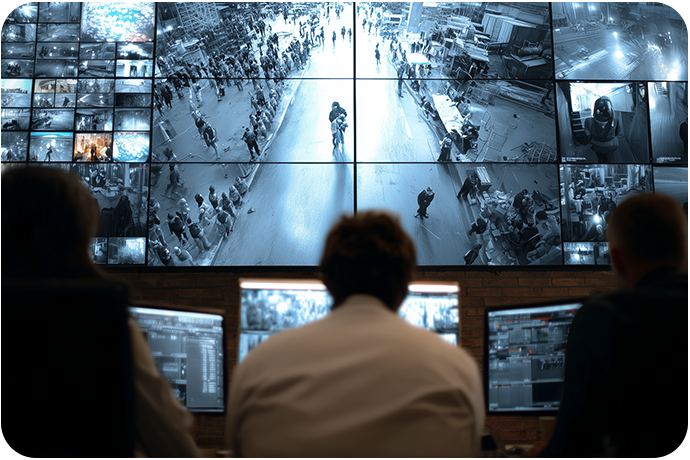
Enterprises today face seven major surveillance challenges: manual monitoring fatigue, high false alarms, delayed incident response, compliance complexity, scalability constraints, limited multi-site visibility, and underutilised video data.
AI-powered, cloud-native surveillance platforms solve these challenges by enabling real-time detection, automated monitoring, centralised visibility, and actionable intelligence at scale.
As threat vectors become more asymmetric and enterprise operations expand across geographies, surveillance must evolve from passive observation to AI-powered smart surveillance – systems capable of interpreting context, prioritising risks, and triggering real-time action.
Below are the top surveillance challenges enterprises face today, and how AI-driven, cloud-native surveillance platforms are fundamentally reshaping the security equation.
1. Manual Monitoring Fatigue
Most traditional surveillance setups depend heavily on human operators watching screens for hours on end. In 24×7 operations, this inevitably leads to fatigue, slower reaction times, and missed incidents. Human attention is finite; threats are not.
How AI helps:
AI-driven systems automate continuous monitoring using AI-Enabled Video Analytics, surfacing only relevant events and anomalies. This shifts security teams from passive viewing to active decision-making – improving vigilance while optimising manpower utilisation.
2. High Rate of False Alarms
Conventional systems generate alerts for shadows, lighting changes, animals, or routine movements. Over time, teams begin to ignore alerts altogether – defeating the purpose of surveillance.
How AI helps:
Advanced computer vision models and deep learning models distinguish between benign activity and real threats. By accurately detecting objects of interests, like People, Vehicles and Animals (PVA) , and contextual behaviour, AI dramatically reduces false alarms and restores trust in alerts.
3. Delayed Incident Detection & Response
Legacy surveillance often works in hindsight. Footage is reviewed after an incident has already occurred – by then, damage, loss, or safety risks are irreversible.
How AI helps:
AI enables real-time detection and response. Suspicious behavior, entries in restricted zones or safety violations can be identified as they happen, allowing immediate intervention rather than post-event analysis.
4. Compliance & Audit Challenges
Enterprises face stringent regulatory, safety, and internal audit requirements. Manual logs, fragmented data, and inconsistent evidence make audits time-consuming and error-prone.
How AI helps:
AI-powered systems automatically log events, generate reports, and maintain structured, searchable evidence trails, simplifying compliance while improving accountability.
5. Difficulty Scaling Surveillance Infrastructure
As enterprises expand across sites and cities, traditional CCTV architectures become expensive and complex. Scaling typically means more infrastructure, more space, power and cooling and most important is compatibility challenges with existing infra along with more on-ground multi skilled manpower.
How AI helps:
Cloud-native platforms enable elastic scalability, allowing enterprises to add cameras, analytics, and locations without re-architecting infrastructure. When deployed as a cloud secure cam, surveillance scales securely while supporting AI-powered energy optimisation through efficient compute and storage utilization.
6. Limited Visibility Across Multiple Locations
Siloed systems prevent centralised oversight. Leadership teams lack a unified view of security posture across locations, making proactive risk management difficult.
How AI helps:
Centralised dashboards provide a single pane of glass for multi-site surveillance, enabling enterprise-wide visibility, standardised policies, and faster escalations.
7. Underutilised Video Data
Enterprises generate massive volumes of video – but most of it remains unused. Without intelligence, video footage offers little beyond basic evidence.
How AI helps:
AI transforms video into actionable insights – from behaviour analysis and operational trends to safety and productivity indicators – unlocking business value far beyond security.
How Drishticam Solves These Challenges with Intelligent Surveillance
Drishticam is a cloud-based CCTV monitoring and video management service platform, designed to address the needs of small, medium, and large multi-enterprise architectures through a modular, scalable approach. Instead of relying on local servers and fragmented systems, Drishticam operates entirely on the cloud – delivering intelligence, flexibility, and cost efficiency at scale.
Security Beyond Limits with AI
Drishticam goes embeds AI-driven intelligence at its core. Real-time object detection, recognition, and behavioir analysis enable enterprises to move from reactive monitoring to proactive security.
– Precision & Accuracy: AI algorithms significantly reduce false alarms while improving detection accuracy.
– Automated Monitoring: Continuous, intelligent monitoring frees human teams from fatigue and ensures round-the-clock vigilance.
– Behaviour Analysis: Advanced analytics identify suspicious patterns, improving situational awareness and threat anticipation.
A Unified, Cloud-Hosted VMS Platform
Drishticam redesigns the Video Management System (VMS) into a world-class unified VSaas platform.
– Access and monitor multi-site cameras from anywhere, anytime through a centralised cloud dashboard.
– Gain clarity across locations with real-time analytics, notifications, and operational insights.
– Scale seamlessly as new cameras or sites are added without re-architecting infrastructure.
Built for Enterprise-Grade Security & Compliance
Security is foundational to DRISHTICAM’s architecture:
– VAPT-certified security
– TLS 1.3 encrypted server-client communication
– Video encryption and secured HTTPS integrations
– All cloud-recorded video is hosted on Yotta Cloud, with data centers located in Mumbai, India, ensuring data sovereignty and regulatory alignment.
Flexible Storage & Hybrid Recording
Drishticam offers flexible storage models tailored to enterprise needs:
– Cloud-based recording with customizable retention policies
– Automatic video archiving
– Support for hybrid setups, allowing simultaneous on-premise edgerecording with cloud backup for longer retention
Seamless Integration & Lower Cost of Ownership
– Open APIs allow easy integration with third-party systems and enterprise applications.
– Support for IP cameras via ONVIF and SDK-based integrations.
– Elimination of expensive on-site servers and maintenance leads to a significantly lower cost of ownership (LCO).
– Automatic updates and cloud management further reduce IT overhead, letting enterprises focus on outcomes-not infrastructure.
The Future of Enterprise Surveillance
The future of enterprise surveillance will be defined by a simple question: does your organisation merely observe risk, or can it anticipate and act on it in real time? As enterprises scale and sustainability becomes a boardroom priority, surveillance will play a critical role beyond security – through video analytics for sustainability, operational efficiency, and energy intelligence. AI-powered platforms like Yotta’s Drishticam mark a decisive shift – from surveillance as a cost center to surveillance as a strategic intelligence layer. For leadership teams, this is no longer a technology upgrade decision; it is a governance, resilience, and competitive positioning imperative. Enterprises that fail to modernise will react to incidents. Those that do will stay ahead of them.