
Cloud-Based VMS
Why AI-Enhanced Video Surveillance Matters For Data Centers
Sashishekar Panda
July 21, 2025


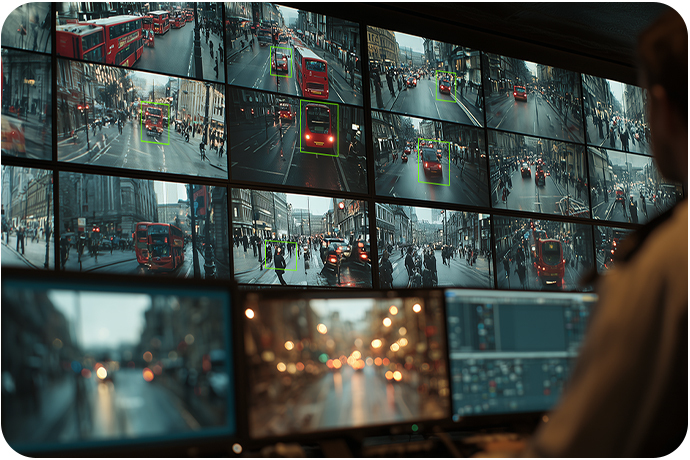
Video surveillance didn’t become critical overnight – it quietly accumulated importance. What began as a compliance checkbox evolved into an always-on data layer as enterprises expanded campuses, factories, retail networks, and public infrastructure. Today, video systems capture identities, movement patterns, and real-world behavior at scale, making surveillance footage one of the most sensitive and operationally valuable datasets organizations manage.
As surveillance grew in scope and strategic importance, investment followed. The global Video Management Software (VMS) market is projected to grow from USD 13.74 billion in 2025 to USD 32.94 billion by 2030, at a CAGR of 19.1%, according to Mordor Intelligence – reflecting a shift in how organizations view video, from a peripheral security function to a core digital infrastructure layer.
Scale, however, exposed structural limits. As deployments expanded across locations and use cases, traditional surveillance architectures – built for localized monitoring – struggled with multi-site complexity. Storage became reactive, access controls fragmented, and resilience relied on on-premise hardware never designed to be a single point of trust. As a result, organizations were left managing high-risk, privacy-sensitive data on platforms with limited visibility, weak governance, and inconsistent security postures.
Cloud Secure VMS emerged not as an incremental upgrade, but as a structural reset. Once video became a governed data asset, it demanded the same discipline as core enterprise workloads centralized policy enforcement, secure access controls, built-in resilience, and scale without compromise. In this context, moving surveillance to the cloud wasn’t about convenience; it was about restoring control over a system that had outgrown its foundations.
Why Cloud-Native Surveillance Is Becoming the Default
The shift toward a cloud-native surveillance solution is fundamentally an architectural decision driven by scalability, fault tolerance, and security consistency. By decoupling video ingestion, storage, and control planes from on-premise hardware, organizations move away from single-site failure domains and capacity-constrained systems. Camera streams are ingested over secure channels into distributed cloud environments where storage and compute scale independently, eliminating the tight coupling between camera growth and local infrastructure expansion.
From a security and data protection perspective, cloud-native VSaaS platforms implement controls that are inherently difficult to standardize across fragmented on-premise deployments. End-to-end encryption secures video streams in transit, while encrypted object storage protects recordings at rest with centralized key management. Automated replication, versioning, and geo-redundant backups ensure data durability and rapid recovery in the event of outages or site-level failures capabilities that would otherwise require complex, costly custom implementations across multiple locations.
Equally important is performance predictability at scale. Cloud architectures distribute load across elastic compute and storage resources, enabling consistent ingestion and retrieval performance even as camera counts grow exponentially. Policy enforcement, access control, logging, and updates are applied centrally, reducing configuration drift and operational risk. As a result, surveillance infrastructure evolves from a collection of isolated systems into a governed, resilient platform that can scale without repeated hardware refresh cycles or security trade-offs.
Strengthening Data Protection and Privacy Controls
Video footage often contains personally identifiable information, making privacy protection a core requirement rather than an afterthought. Cloud Secure VMS platforms are designed with access control and accountability at the center. Role-based permissions ensure that users can only view or manage feeds relevant to their responsibilities, while detailed audit logs provide traceability for every action taken within the system.
Centralized identity management and multi-factor authentication reduce the risk of unauthorized access, especially in environments where multiple teams or third-party vendors interact with the surveillance system. In addition, cloud-hosted platforms make it easier to align with regulatory and industry compliance standards by applying uniform security configurations across all deployments.
Data resilience is another key differentiator. Cloud-based systems store video data redundantly across secure locations, reducing the risk of loss due to hardware failure, theft, or local disruptions. This is particularly important for sectors such as banking, healthcare, transportation, and government, where video evidence may be critical for audits, investigations, or legal proceedings.
Moving from Passive Monitoring to Intelligent Surveillance
One of the most significant advancements in modern surveillance is the integration of AI-Enabled Video Analytics. Instead of relying solely on human monitoring, AI-driven systems can automatically detect anomalies, recognize predefined patterns, and trigger alerts in real time. This reduces response times and minimizes reliance on continuous manual observation.
When analytics are deployed in the cloud, they benefit from elastic compute resources. Processing capacity can scale dynamically based on workload, allowing organizations to analyze large volumes of video data without performance bottlenecks. This enables use cases beyond security, including crowd management, operational efficiency analysis, and safety monitoring, while still maintaining strict access controls around sensitive footage.
Operational Efficiency and System Scalability
Cloud Secure VMS platforms are designed to integrate with a wide range of camera models and legacy systems, protecting existing investments while enabling modernization. Centralized dashboards provide a unified view of all connected sites, simplifying monitoring and administration. Multi-device access ensures that authorized personnel can securely access the system from desktops, web interfaces, or mobile devices, enabling faster decision-making during incidents.
Automated updates and centralized maintenance reduce the operational burden on internal IT teams. Instead of managing patches, firmware upgrades, and storage expansion at each site, organizations can rely on the cloud platform to handle these tasks consistently and securely.
Drishticam: A Cloud-Native VMS Built for Scale, Security, and Governance
Yotta’s Drishticam is a cloud-native, secure VMS purpose-built to address these challenges at enterprise scale. It enables organizations to connect and manage cameras entirely through the cloud, removing the dependency on on-site servers and fragmented infrastructure. Cameras across multiple locations can be registered, monitored, and managed centrally, improving visibility while simplifying operations. Secure multi-device access allows authorized users to monitor feeds and review recordings from anywhere, without compromising data integrity or access controls.
Beyond core functionality, Drishticam is designed to meet the needs of diverse sectors including education, government, transportation, industrial facilities, hospitality, residential complexes, banking and finance, and healthcare. Features such as real-time alerts, scalable architecture, and centralized monitoring support both security and compliance requirements across these environments. Backed by robust cloud infrastructure and dedicated support, Drishticam prioritizes system reliability and data protection while remaining flexible enough to scale from small deployments to large enterprise environments.
Managing video as a high-risk data asset requires consistent security controls, auditability, and resilience at scale. Drishticam is a cloud-native VMS that delivers these capabilities through centralized management and secure, scalable design.
